
27August 2026
If you’re a Hamilton homeowner wondering what a $10,000 bathroom remodel can actually get you, the honest answer is: quite a lot, if you plan smart. But it’s not about gutting everything and starting from scratch. It’s about knowing where to spend, where to save, and how to protect your budget from the hidden surprises that older homes often throw your way.
I’ve worked on dozens of bathroom projects across Southern Ontario, from quick cosmetic refreshes to full repairs in century-old houses. And I’ve seen firsthand how a $10k budget can either deliver a beautiful, functional bathroom, or vanish quickly if you’re not strategic. Here’s exactly what you can expect, based on real projects, real problems, and real solutions.
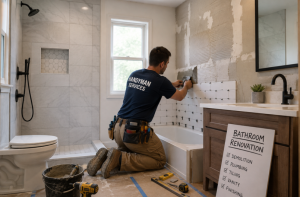
Three Realistic $10K Bathroom Scopes I’ve Seen Work
Not every $10,000 bathroom looks the same. The key is matching your budget to a realistic scope, and resisting the urge to move plumbing or change layouts unless absolutely necessary. Here are three common project types I’ve completed near this budget:
1. Main Bathroom Refresh ($8,000–$10,000)
This is the most common and most successful $10k project. You keep the existing tub, shower, toilet, and vanity locations, but replace everything that’s dated or worn.
Typical scope includes:
-
New vanity and countertop
-
New faucet and sink
-
New toilet
-
New mirror and light fixture
-
New vinyl or tile flooring
-
Fresh paint on walls and ceiling
-
New baseboards and trim
-
Re-caulking around tub and sink
-
Minor plumbing repairs (like fixing a slow drain or leaky supply line)
-
Installation of new accessories (towel bars, toilet paper holder, etc.)
I’ve seen bathrooms where the tub was perfectly fine, but everything around it looked like it hadn’t been touched since the 1990s. By focusing the budget on vanity, flooring, fixtures, lighting, and finishes, homeowners got a completely transformed space without paying for unnecessary demolition or plumbing work.
2. Tub/Shower Surround + Vanity Upgrade ($9,000–$11,000)
This scope targets the wet area, the part of the bathroom that gets the most use and shows wear first. You keep the plumbing where it is but substantially improve the shower or tub surround and update the vanity.
Typical scope includes:
-
Remove old tub surround
-
Repair or replace damaged backer board as needed
-
Install new tile or quality surround system
-
Replace shower valve and trim
-
Install new showerhead
-
Replace vanity and countertop
-
Install new sink faucet
-
Replace flooring
-
Re-grout and re-caulk all wet areas
-
Paint walls and ceiling
-
Replace damaged trim
This is where I always tell Hamilton homeowners to budget for surprises. You might start with what looks like a simple surround replacement, and discover water damage behind the old tile. If the framing or subfloor has been affected, that’s no longer just a cosmetic upgrade. A $10,000 budget works much better when you keep the toilet, tub, and vanity locations exactly where they are.
3. Older Hamilton Bathroom — Repair First, Then Refresh ($7,500–$10,000+)
In older homes, the priority isn’t always how the bathroom looks, it’s making sure it’s sound. I’ve worked on projects where the homeowner originally wanted new tile and a vanity, but the first step was correcting plumbing, flooring, or moisture problems.
Typical scope includes:
-
Repair leaking supply or drain connections
-
Replace damaged sections of subfloor
-
Reinforce or repair areas around the toilet
-
Remove failing caulk and grout
-
Install new vanity
-
Replace flooring
-
Repair or replace sections of wall
-
Upgrade lighting and exhaust fan
-
Paint
-
Re-caulk all wet areas
In these cases, the most important part of the $10,000 isn’t the fancy finish—it’s ensuring you’re not covering up a problem that’ll come back six months later.
A Real Case Study: When $10K Became $12K (And Why the Client Was Glad)
One project that sticks with me involved a bathroom in an older Hamilton home. The homeowner came to me with a $10,000 budget and a clear plan: replace the vanity, update the flooring, redo the tub surround, install new fixtures, and paint everything.
Once we removed the old tub surround, the situation changed.
The Hidden Problem
Behind the surround, we found deteriorated wall material and damaged framing around the wet area. The homeowner had assumed the old caulking and grout were just tired-looking, but water had been seeping where it shouldn’t for years.
This is exactly why I never promise a $10,000 bathroom will stay at $10,000. You can price the visible work accurately, and still not know what’s behind a wall until you open it.
How I Handled the Conversation
I stopped work immediately. I showed the homeowner exactly what we’d uncovered and explained what was necessary versus optional. I gave them two choices:
-
Do the necessary repairs and keep the rest of the renovation modest, staying reasonably close to the original budget.
-
Turn it into a more extensive renovation, increasing the budget considerably.
My recommendation? Fix the underlying problem first. We scaled back some of the finishes and concentrated the money on properly rebuilding the wet area.
The Final Result
Instead of forcing the entire original wish list into $10,000, the homeowner ended up spending roughly $11,000–$12,000, depending on final fixture selections. The project also took several extra days due to demolition, drying, repair work, and rebuilding.
The homeowner was initially disappointed about the added cost, which is understandable. But once everything was opened up, they could see why the extra work was necessary. They were much happier spending another couple thousand dollars fixing the underlying problem than putting a beautiful new bathroom over damaged materials.
That’s my biggest lesson from older Hamilton bathrooms: don’t spend your entire $10,000 budget on what you can see. Keep some money in reserve for what you can’t see.
My 3 Non-Negotiable Spending Rules for a $10K Bathroom
After years of working on bathrooms across Southern Ontario, I’ve developed strong opinions on where to spend, and where not to, within a $10,000 budget. These aren’t theoretical. They’re based on what holds up, what fails, and what delivers real value.
1. Spend on the Wet Area and Waterproofing — Don’t Cheap Out on What’s Behind the Tile
Always spend money on proper waterproofing, quality installation, and fixing leaks or damaged substrate. If we’re working around a tub or shower, that’s where I want the budget to go first.
Good tile on top of a poorly prepared or improperly waterproofed surface is a false economy. In older Hamilton homes especially, I’d rather have a basic-looking shower that’s properly built than a beautiful shower that’s going to develop moisture problems.
My rule: fix water problems before buying pretty finishes.
2. Spend on the Fixtures You Use Every Day — Don’t Overspend on Designer Finishes
I’d put reasonable money into the toilet, faucet, shower valve, showerhead, and vanity hardware, because these are things you’re going to touch and use constantly.
But I don’t think a $10,000 bathroom needs a $2,000 designer faucet or an ultra-expensive vanity just because it has a recognizable brand name. There are plenty of good mid-range products that look great and perform well.
I’d rather install a reliable $400–$700 faucet and put the savings toward proper installation and repairs than spend the entire amount on a luxury fixture.
3. Spend on Preparation and Workmanship — Don’t Waste the Budget Moving Plumbing Unnecessarily
This is probably my biggest money-saving rule. If the toilet, vanity, tub, and shower are already in reasonable locations, leave them there. Moving plumbing can quickly turn a straightforward bathroom refresh into a much larger renovation.
I’d spend the money on:
-
Proper demolition and preparation
-
Correcting uneven or damaged surfaces
-
Good tile installation
-
Proper waterproofing
-
Quality caulking and grout
-
Solid vanity installation
-
Good lighting and ventilation
-
Fixing anything that’s actually causing a problem
I would not spend thousands simply to move a toilet six feet across the room because the homeowner saw that layout in a magazine.
For a Hamilton homeowner with $10,000, my priority order is:
-
Water and structural problems
-
Installation quality
-
Everyday fixtures
-
Cosmetic upgrades
If there’s money left after those, then go ahead and splurge on the fancy tile or feature wall.
Products I Recommend (And Avoid) in a $10K Remodel
I’m much more interested in how a product performs in a real bathroom than whether it’s currently trendy. For a $10,000 remodel, I want materials that are durable, forgiving, and easy to maintain.
I Consistently Recommend Quality LVP/SPC Flooring
For homeowners who don’t specifically want ceramic or porcelain tile, I’m a big fan of good-quality waterproof LVP (luxury vinyl plank) or SPC (stone plastic composite) flooring.
The reason is practical: it’s relatively quick to install, comfortable underfoot, easy to clean, and doesn’t require the same amount of labour as a traditional tile floor. In a $10,000 budget, saving some installation cost on the floor can allow the homeowner to put more money into the shower area, vanity, or necessary repairs.
The important part is buying a quality product and preparing the floor properly. I wouldn’t put inexpensive flooring over an uneven or damaged subfloor just because the material is advertised as waterproof.
I Prefer Proven Mid-Range Plumbing Fixtures Over Bargain or Ultra-Trendy Hardware
For faucets, shower valves, and other plumbing fixtures, I generally recommend sticking with established plumbing brands such as Moen, Delta, or Kohler, rather than buying the cheapest fixture available online.
I’m not saying homeowners need the most expensive model. Quite the opposite. A good mid-range fixture from a reputable manufacturer usually gives you a better combination of reliability, replacement parts availability, and warranty support.
I’ve also learned to be cautious about trendy, no-name fixtures with unusual cartridges or proprietary parts. They can look fantastic when they’re new, but if something starts leaking a few years later and you can’t find the replacement cartridge, that inexpensive purchase can become a headache.
My Hamilton $10k bathroom rule is simple: save money on things that are easy to replace, and don’t compromise the parts that are behind the walls or exposed to constant water. I’d rather see a homeowner choose a reasonably priced floor and vanity and put the savings toward quality plumbing components and proper waterproofing.
Why Hamilton’s Older Homes Change the Game
About 33% of Hamilton’s dwellings were built in 1960 or earlier, compared with 23% across Ontario. That matters a lot when you’re trying to hold a bathroom remodel to $10,000.
In an older Hamilton bathroom, I don’t assume that what looks like a cosmetic renovation is actually just cosmetic. Once you remove an old vanity, toilet, tub surround, or flooring, you can find deteriorated subfloor, outdated plumbing, moisture damage, or other work that needs attention.
So my advice is to plan the $10,000 differently from the beginning.
I typically tell homeowners:
-
Don’t spend the entire $10,000 on fixtures and finishes. Keep roughly 10–20% available as a contingency for surprises.
-
Keep the existing bathroom layout whenever possible. Moving plumbing can add cost, and in Hamilton, new or relocated plumbing can trigger permit requirements. The City specifically lists new or relocated plumbing among work requiring a building permit, while replacing existing plumbing fixtures in the same location generally does not.
-
Open up questionable areas early. I’d rather discover a problem at the beginning than after we’ve installed an expensive new vanity, flooring, and tile.
-
Fix water and structural problems before cosmetic work. If the subfloor is damaged or there’s evidence of a long-term leak, that’s where the money needs to go first.
There’s also a Southern Ontario winter consideration. Hamilton specifically warns that pipes in unheated areas can freeze during extended periods of very low temperatures, so when we’re dealing with older plumbing or exposed pipes, I pay attention to insulation, air leaks, and where the plumbing is located.
My Hamilton rule of thumb is: don’t design a $10,000 bathroom around the assumption that everything behind the walls is perfect. Design it so you can handle a reasonable surprise without having to stop the project halfway through.
That’s why I’d rather see a Hamilton homeowner choose a $8,000–$9,000 core renovation with some money held back than spend the entire $10,000 on beautiful finishes, and have no budget left when an older-home problem shows up.
Final Thoughts: What $10K Really Buys You
A $10,000 bathroom remodel in Hamilton can deliver a fresh, functional, and beautiful space, if you’re strategic. It won’t buy you a full gut job with custom tile and heated floors. But it will buy you a major upgrade if you keep the layout, fix water issues first, invest in quality fixtures and installation, and leave room for surprises.
The homeowners who get the most value aren’t the ones who chase trends, they’re the ones who prioritize durability, function, and smart spending. And in a city like Hamilton, where older homes hide more than they show, that approach isn’t just smart, it’s essential.
If you’re planning a bathroom remodel and want honest, local advice on what’s realistic for your budget, feel free to reach out. I’ve helped countless Hamilton homeowners navigate this exact question, and I’m happy to help you too.