
22August 2026
If you’re researching gutter installation costs around Hamilton, Burlington, Oakville, Mississauga, or Brampton, you’ve probably seen a wide range of prices per linear foot. Some contractors advertise very low numbers. Others quote significantly higher. It can be confusing to know what’s actually fair.
As a Hamilton-area handyman who has worked on many gutter installation and repair projects throughout the region, my goal is to give you a clear, realistic picture of what you should expect to pay, what can change that price, and how to compare quotes without getting misled by a headline number.
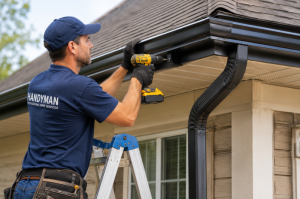
What’s a Fair Price Per Linear Foot for Gutters in Hamilton-Area Homes?
From a Hamilton handyman point of view, a realistic all-in price for standard aluminum K-style gutter installation (materials plus labor) typically falls in the $8–$12 per linear foot range for the gutter itself on straightforward residential jobs.
That range assumes:
-
Standard aluminum K-style gutters
-
Normal residential access (no extreme height or complex scaffolding)
-
No major fascia or soffit repairs
-
Basic cleanup and disposal included
Once you add the supporting pieces that make the system work properly, the effective price per linear foot usually shifts:
-
Gutters only: about $8–$12/linear ft
-
Gutters + standard downspouts: roughly $10–$15/linear ft, depending on how many downspouts are required
-
Gutters + downspouts + splash pads/extensions: approximately $11–$16/linear ft
For example, on a 200-linear-foot house, a straightforward complete installation might land somewhere around $2,200–$3,200 all-in, assuming normal access, standard aluminum K-style gutters, a reasonable number of downspouts, extensions or splash pads, and no major fascia repairs.
The important thing to understand is that one contractor might quote $9/ft for gutters only, while another quotes $14/ft but includes downspouts, extensions, hangers, removal of the old system, disposal, and cleanup. The second quote can actually be the better value, even though the per-foot number looks higher.
Real Jobs: When Gutter Costs Go Higher or Lower Than “Standard”
Linear footage alone doesn’t tell you what a gutter installation will cost. Two houses with similar square footage can have very different prices because of height, roof complexity, access, and the condition of the wood behind the gutters.
Higher-than-normal cost: a Hamilton two-storey home
I worked on a detached home in Hamilton where the homeowner initially expected a fairly straightforward gutter replacement. The house was around 2,400 sq. ft., but the actual job was more complicated because of:
-
Two-storey height and more difficult access
-
Multiple roof sections and valleys
-
Deteriorated fascia behind several sections of gutter
Once the old gutters came off, we found that some of the fascia couldn’t properly hold new hangers. We had to repair those sections before installing the new aluminum K-style gutters. There were also several downspouts that needed to be repositioned to handle the roof runoff properly.
Instead of coming in around the normal $8–$12/linear-foot gutter-only range, the complete project worked out closer to $15–$18 per linear foot when everything was included. The extra cost wasn’t really the gutter material. It was the access, fascia repairs, additional downspout work, and labour involved in working around the more complicated roofline.
Lower-end installation: a simple Oakville ranch-style home
On another job in Oakville, the situation was much easier. It was a relatively simple ranch-style detached house with:
-
Easy ground-level access
-
A straightforward roofline
-
Good existing fascia
-
Minimal downspout changes
We were able to remove the old gutters quickly, install standard aluminum K-style gutters, reuse some of the existing drainage locations, add extensions/splash pads, and clean everything up without encountering any surprises. The finished price worked out around $9–$11 per linear foot all-in, which was right around the lower end of the normal range.
The takeaway is simple: a 200-foot house with a simple roof can be considerably cheaper than a 150-foot house with two storeys, difficult access, multiple valleys, damaged fascia, and complicated downspout routing.
Common Mistakes Homeowners Make When Comparing Gutter Quotes
When homeowners in Hamilton, Burlington, and Oakville ask me what a fair price per foot for gutters is, I often see the same mistakes repeated when they compare quotes. Avoiding these can save you money and headaches.
Comparing the $/ft number instead of the complete scope
A $9/ft quote isn’t necessarily cheaper than a $13/ft quote. The first contractor may be pricing gutters only, while the second includes:
-
Downspouts
-
Extensions or splash pads
-
Removal of the old system
-
Disposal and cleanup
Always compare the same scope of work line by line. Ask each contractor to clearly state what is and isn’t included in their per-foot price.
Underestimating the importance of downspouts
Homeowners often focus on how many linear feet of gutter they have and forget that downspout quantity and placement are just as important. A long roofline with too few downspouts can overwhelm the system during heavy Hamilton-area rainfall.
Adding downspouts or relocating them can change the price significantly, but it’s often necessary to protect your foundation and landscaping.
Not checking the fascia before accepting the quote
This is especially important on older homes. New gutters need something solid to attach to. If the fascia is rotten or damaged, simply installing new gutters over it isn’t a proper solution.
A quote can look inexpensive until the installer discovers that the wood needs repair or replacement. A good installer will inspect the fascia, soffit, and roof edge before giving a firm price and will explain any needed repairs up front.
Assuming all aluminum gutters are basically the same
Gauge or thickness, profile, finish, hanger system, fasteners, and installation quality can all vary. The cheapest aluminum option isn’t automatically a bad product, but you should ask:
-
What gauge or thickness is being used?
-
What hanger system will be installed?
-
How will seams and corners be handled?
Comparing prices based solely on “aluminum gutters” without these details can lead to unpleasant surprises later.
Not accounting for the house itself
A single-storey bungalow with a simple roofline is completely different from a two-storey home with:
-
Multiple roof sections
-
Valleys and dormers
-
Difficult access
-
Complicated drainage
Height, roof complexity, access, and fascia condition can have a bigger impact on the final price than a few dollars per linear foot.
What Actually Makes a Gutter Installation “Good” vs. “Cheap”
Beyond price, there are clear signs that separate a quality gutter installation from a rushed or poorly planned one. These are the things I look for on every job.
Proper slope and drainage
Gutters should have a consistent pitch toward the downspouts. They shouldn’t look obviously crooked, but they also shouldn’t be perfectly level if that prevents water from draining.
After installation, the system should be tested so water actually flows toward the downspouts rather than sitting in the gutter. Standing water is a sign of poor slope and will lead to overflow, debris buildup, and premature wear.
Good hanger spacing and solid attachment
This is one of the easiest ways to spot a rushed installation. Gutters need enough properly secured hangers to prevent sagging, especially in Ontario winters when they can be carrying snow, ice, and water.
The hangers should be fastened into solid structure, not just loosely attached to questionable fascia. If the wood behind the gutter is soft or rotten, it needs to be repaired before new hangers are installed.
Downspouts that are properly sized and positioned
A beautiful gutter installation isn’t much good if the drainage system can’t handle the roof area. Pay attention to:
-
Where the downspouts are located
-
Whether there are enough of them for the roof area
-
Whether extensions actually move water away from the foundation
On larger or more complicated roofs, this becomes especially important. Undersized or poorly placed downspouts are a common cause of basement water issues.
How the installer deals with the fascia and roof edge
Before installing anything, a good installer should inspect the wood behind the gutter. If the fascia is rotten, they should point it out and explain the repair rather than simply covering the problem with new gutters.
A new gutter system is only as good as what it’s attached to. Ignoring bad fascia might save money today but will cost more in the long run when the gutters pull away or the wood fails.
Clean seams, corners, and overall finishing
On sectional gutters, look closely at the seams and corners. They should be:
-
Neat and properly sealed
-
Positioned where they make sense, not just where they’re easiest for the installer
-
Consistent in appearance with no obvious sagging, waves, or poorly aligned downspouts
The finished gutter should look intentional and well planned, not slapped on as quickly as possible.
How to Get a Fair, No-Surprise Gutter Quote in Hamilton and Surrounding Areas
As a Hamilton-area handyman, I’ve worked on a variety of gutter installation and repair projects throughout Hamilton, Burlington, and surrounding communities. My focus is on giving homeowners straightforward recommendations, explaining what they’re actually paying for, and providing a clear quote before the work starts.
I’m not a large roofing or gutter company. I approach each job as a handyman who looks at the whole house: gutters, fascia, soffit, drainage, exterior maintenance, and related repairs. That perspective helps catch issues that a purely gutter-focused crew might miss.
When you’re getting quotes, ask each contractor to provide:
-
An all-in price, not just a $/ft number
-
A clear breakdown of what’s included (gutters, downspouts, extensions, removal, disposal, cleanup)
-
An assessment of the fascia, soffit, and roof edge condition
-
An explanation of how many downspouts they recommend and why
-
Details on the gutter material, gauge, and hanger system they plan to use
Avoid anyone who promises an exact “$X per linear foot” price without seeing the home. The final cost depends on the home’s height, roof design, gutter size, number and location of downspouts, access, fascia condition, materials, removal, and other site conditions.
Most importantly, you want a contractor who will tell you what actually needs to be done, explain why it costs what it costs, and not surprise you with unnecessary work. That’s the kind of approach I aim for on every gutter project in Hamilton, Burlington, Oakville, Mississauga, and Brampton.