
15August 2026
A leaning fence post does not always mean you need a new fence. In many Hamilton homes, the post has shifted because of frost movement, loose soil, poor drainage, or a failed footing. In other cases, the post is rotten at ground level and needs to be replaced.
The important question is not simply, “How do I make the post straight again?” It is:
Why is the post leaning, and is the post still strong enough to repair?
From my experience as a Hamilton handyman, I have found that a leaning post is usually a symptom of a larger problem. The right repair depends on what is happening below the soil line, how stable the surrounding fence is, and whether the post is supporting a normal fence panel or a heavy gate.
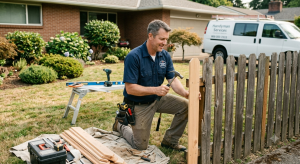
Why Fence Posts Lean in Hamilton
Hamilton winters can be hard on outdoor structures. Freeze-thaw cycles, wet soil, and uneven settling can gradually move fence posts and concrete footings. Older fences are especially vulnerable if the posts were not installed deeply enough or the original footings were too small.
Frost movement and poor footing
When water in the soil freezes, it expands. This can push a fence post or its concrete footing out of position. When the ground thaws and settles again, it may not return to its original position.
This process can happen repeatedly over several winters. Eventually, the post begins to lean, the fence panel shifts, and the rails may pull away from the post.
Poor footing makes the problem worse. If a post was installed too shallowly, surrounded by too little concrete, or placed in loose soil, it may look perfectly straight when new but become unstable after several Hamilton winters.
Rotten wood at ground level
Rot is one of the most common reasons a fence post fails. The problem is often concentrated at the soil line, where the post is exposed to moisture, oxygen, and changing temperatures.
A post may look solid from several feet away while being badly deteriorated at its base. I have removed posts that appeared reasonably good above ground but were almost gone where the wood entered the soil.
Once the post is rotten at ground level, the fence panel and rails no longer have reliable support. Straightening the post may improve its appearance temporarily, but it will not restore its structural strength.
Poor installation
Some leaning fences show signs of installation shortcuts, including:
-
Posts that were not set deeply enough.
-
Concrete footings that were too small.
-
Loose soil that was not properly compacted.
-
Posts installed without considering drainage.
-
Inadequate support for large gates.
-
Fence rails or panels putting excessive pressure on individual posts.
These problems may not be obvious during the first year or two. Over time, however, weather and normal fence movement expose weak installation practices.
Soil movement and drainage problems
Water that continually collects around a fence post can soften the soil and accelerate wood deterioration. Sloped yards may also place additional pressure on the fence line, especially where the soil has been disturbed or does not drain properly.
Standing water, soft soil, and soil that has washed away from the post are warning signs that should not be ignored.
Impact damage
Some leaning posts are caused by sudden damage rather than gradual movement. Common examples include:
-
A vehicle or trailer backing into the fence.
-
Lawn equipment bumping the post.
-
Falling branches.
-
Children or pets pushing against a weak section.
-
A post being struck during landscaping work.
An impact can loosen the footing, crack the post, damage the rails, or create problems that become worse during the next freeze-thaw cycle.
Heavy gates
A gate post carries much more stress than a post supporting a standard fence panel. Every time a heavy gate opens and closes, the hinge post handles the gate’s weight and the leverage created by its movement.
A gate that drags, swings differently, or no longer latches properly may not have a hinge problem. The supporting post may have shifted or started to fail.
Adjusting the hinges without stabilizing the post often treats the symptom rather than the cause.
Is a Leaning Fence Post a DIY Repair?
A DIY repair can make sense when the post is structurally sound and has simply moved out of alignment. Before attempting the repair, inspect the post carefully around the soil line.
Push the post and watch what moves. If the entire footing shifts but the wood remains solid, the post may be a reasonable repair candidate. If the wood itself flexes, feels soft, or shows serious damage, it likely needs to be replaced.
When DIY may be reasonable
A homeowner may be able to repair a relatively minor lean when:
-
The post is solid at and below the ground line.
-
There is no significant rot or insect damage.
-
The post is not badly cracked or split.
-
The surrounding fence panels and rails are still in good condition.
-
Only one post is affected.
-
The post is not supporting an unusually heavy gate.
-
The homeowner can safely excavate and brace the post.
A basic repair may involve exposing the base, bringing the post back to plumb, and rebuilding the support around it. In some cases, compacted soil may be appropriate. In others, fresh concrete or a more substantial reset may be needed.
Do not judge the repair only by how straight the fence looks. After the repair, push on the fence. If the post still moves substantially, the underlying problem has not been solved.
When replacement is the better choice
I would recommend replacing the post if it has:
-
Rot at the ground line.
-
Soft or spongy wood.
-
Severe cracking or splitting.
-
Insect damage.
-
Significant impact damage.
-
A history of repeated repairs.
-
An undersized design that cannot properly support the fence or gate.
Adding screws, brackets, or extra pieces of lumber to a rotten post does not make it structurally sound. It may hold the fence temporarily, but the damaged wood remains the weak point.
A proper replacement usually involves removing the failed post, installing a suitable pressure-treated post, establishing a stable footing, and reattaching the existing rails and panels if they are still usable.
When to call a professional
Professional help is usually worthwhile when the repair involves:
-
Substantial excavation.
-
A large or deep concrete footing.
-
Multiple leaning posts.
-
Difficult access.
-
Significant soil movement.
-
A heavy gate.
-
A fence that has shifted considerably.
-
An older fence with deteriorated rails and panels.
One post may appear to be the problem, but the surrounding posts may also be loose. If several posts are moving, replacing only the most visible one may provide a short-term cosmetic improvement without addressing the larger issue.
Repair Methods That Can Work
The repair method should match the cause of the lean. A solid post with a failed footing requires a different solution from a rotten post or a gate post that is carrying too much weight.
Resetting a solid post
For a solid wood post that has shifted, I usually start by exposing enough of the base to understand what has happened. Once the post is returned to a plumb position, I temporarily brace it so it cannot move while the support is rebuilt.
Depending on the soil and footing, the repair may involve:
-
Digging around the post with a post-hole digger or digging bar.
-
Removing loose or disturbed soil.
-
Checking the post for damage below the visible soil line.
-
Using a level to check plumb in both directions.
-
Temporarily bracing the post with scrap lumber.
-
Adding fresh concrete where the existing footing has failed.
-
Repacking suitable soil in compacted layers where appropriate.
-
Reattaching loose rails with exterior-rated structural screws.
-
Checking that water drains away from the post.
Simply pushing a post upright and pouring loose soil into the hole is not a reliable repair. The post may look straight for a few weeks, but heavy rain or another freeze-thaw cycle can move it again.
Replacing a rotten post
If the wood is deteriorated at ground level, the post should be removed rather than reinforced. The replacement post needs to be appropriate for exterior use and properly supported for the conditions.
If the existing fence panels and rails are still in good condition, they can often be reused. This is one reason a leaning post does not automatically mean the entire fence must be replaced.
The new post should be checked carefully for plumb before the footing is finalized. The rails and panels should also be reattached without forcing them to pull the post out of alignment.
Repairing a heavy gate post
A heavy gate requires extra attention because it creates leverage every time it moves. If the hinge post has shifted, adjusting the hinges alone will not solve the problem.
The proper repair may involve:
-
Resetting a sound post with a substantial footing.
-
Replacing a rotten or undersized post.
-
Checking the gate’s weight and alignment.
-
Inspecting the hinges and latch.
-
Confirming that the gate does not drag.
-
Adjusting the hardware after the post is stable.
I treat a gate post more like a structural support than an ordinary fence post. A quick cosmetic repair may fail because the post is still carrying the same excessive load.
Tools and Materials for a Basic Repair
The tools required depend on the size of the repair, but a straightforward job may involve:
-
Post-hole digger.
-
Digging bar.
-
Shovel.
-
Level.
-
Tape measure.
-
Drill or impact driver.
-
Exterior-rated structural screws.
-
Galvanized exterior fasteners.
-
Wrench or socket set.
-
Pry bar.
-
Saw.
-
Temporary bracing lumber.
-
Concrete mixing equipment.
-
Work gloves and eye protection.
The level is one of the most important tools. A post can look straight from one direction while leaning noticeably from another. Check it in both directions before reattaching the fence.
Fasteners also matter. Ordinary interior screws are not designed for prolonged outdoor exposure and may rust or deteriorate quickly. Use fasteners rated for exterior applications and suitable for use with pressure-treated lumber.
DIY Mistakes That Commonly Fail
Some repairs fail because the homeowner misdiagnoses the problem. Others fail because the repair only improves the appearance of the fence.
Reinforcing rotten wood
Adding a few screws, brackets, or boards to a rotten post does not restore the strength of the damaged wood. If the post is soft at the ground line, it is not a reliable structural support.
Filling the hole with loose soil
Straightening a post and filling the hole with loose soil may provide a temporary result. Soil needs to be suitable for the application and compacted properly. If the footing has failed, the repair may require a more substantial reset.
Using small metal stakes as a permanent fix
Small stakes and thin fence brackets may provide temporary stabilization in limited situations. They are not a substitute for a properly supported post when the fence is carrying significant weight or dealing with unstable soil.
Ignoring the surrounding fence
A single leaning post may be the first visible sign of a larger problem. Check the neighbouring posts, rails, panels, drainage, and fence line before deciding on the repair.
Straightening by eye
A post that looks straight from the street may still be leaning in another direction. Use a level and check the post after the fence panel has been reattached.
Adjusting a gate instead of fixing the post
If the hinge post has moved, repeated hinge adjustments may not last. Stabilize the post first, then adjust the gate hardware.
Hamilton Fence Repair Examples
Real-world repairs often show why diagnosis matters more than appearance.
The post that looked worse than it was
One older backyard fence had a post with a noticeable lean after winter. The homeowner assumed the post was rotten and was considering replacing the entire section.
After exposing the base, I found that the wood was still solid. The footing had shifted, and the surrounding soil had loosened.
I removed enough soil to assess the base, brought the post back to plumb, temporarily braced it, and rebuilt the support. I also resecured the rails that had loosened when the post moved.
The fence had been leaning several inches. After the repair, it was straight and stable again, and the homeowner was able to keep the existing panels.
This is a good example of when repairing one post can provide much better value than replacing a fence section that is otherwise in good condition.
The post that looked fine but was rotten
Another common situation is a fence that looks reasonably good except for one leaning section. From the yard, the post may appear acceptable, but digging around the base reveals severe deterioration at the soil line.
In that situation, I do not try to straighten and reinforce the existing post. The correct solution is to remove the damaged post, install a new pressure-treated post with proper support, and reattach the existing panels and rails if they are still sound.
The homeowner does not necessarily need a new fence. Replacing the individual failed post can restore the section while preserving usable materials.
The heavy gate that pulled the post over
I have also seen gate posts lean toward the opening because of the weight and leverage of a large wooden gate. The gate begins dragging or stops latching properly, and the first instinct is often to adjust the hinges.
If the post has moved, hinge adjustments are only treating the symptom. The supporting post must be stabilized or replaced before the gate can be properly aligned.
Once the post is solid, the hinges and latch can be adjusted so the gate opens, closes, and latches correctly.
The fence where several posts were moving
The more serious jobs are the ones where one leaning post attracts attention, but the next several posts also move when pushed.
That pattern can point to poor original installation, soil movement, drainage issues, or repeated frost-related movement. Replacing one post may make the fence look better temporarily, but another post may begin leaning soon afterward.
In these cases, I inspect the entire fence run and compare the cost of multiple repairs with the remaining life of the fence.
Repair Versus Fence Replacement
The cheapest repair is not always the most affordable solution over time. If a temporary fix fails six months later, the homeowner may end up paying for the same work twice.
When evaluating a leaning fence post, I consider:
-
The condition of the post.
-
The condition of the footing.
-
The age and remaining life of the fence.
-
The condition of the panels and rails.
-
The number of affected posts.
-
Whether a gate is involved.
-
Drainage and soil conditions.
-
The accessibility of the work area.
-
The likely durability of the proposed repair.
If one post has shifted but the rest of the fence is sound, resetting or reinforcing that post can be excellent value. If several posts are rotten and the rails and panels are also deteriorating, putting significant money into individual repairs may not make financial sense.
The goal is not simply to offer the least expensive option. It is to recommend the repair that is most likely to solve the problem properly.
Warning Signs to Watch For
Hamilton homeowners should inspect the fence when they notice:
-
A post that suddenly develops a noticeable lean.
-
A fence section that moves when pushed.
-
Cracked or deteriorated wood around the ground line.
-
A gate that drags or no longer latches.
-
A gate that swings differently than it used to.
-
Fence panels pulling away from the rails.
-
Concrete footings that have lifted or shifted.
-
Several neighbouring posts beginning to lean.
-
Standing water around the base of a post.
-
Large gaps appearing beneath the fence after winter.
A single loose post is usually easier and less expensive to repair than an entire fence line that has started moving.
Seasonal Fence Maintenance
Spring is the best time to inspect a fence in Hamilton because winter movement becomes easier to see after the ground thaws.
Walk the entire fence line and look for movement rather than waiting until something breaks. Push gently on the posts, check the rails and panels, and inspect the soil line for rot or damage.
Fall is another good time to check the fence before winter. Make sure that:
-
Loose panels are secured.
-
Rails are properly attached.
-
Gates close and latch correctly.
-
Water is not collecting around the posts.
-
Leaves and debris are not creating a constantly wet area.
-
Obvious damage is repaired before the freeze-thaw cycle begins.
Good drainage is one of the most important ways to protect wood fence posts. Keep soil, leaves, and other debris from building up around the base, and address areas where water consistently collects.
Do not ignore a gate that is becoming harder to close. A small alignment issue can eventually turn into a leaning or failing gate post.
Final Advice From a Hamilton Handyman
My main rule is simple: fix the cause, not just the lean.
If the post is solid and the footing has shifted, DIY straightening and reinforcement may be reasonable. If the post is rotten, badly cracked, undersized, or supporting a heavy gate, replacement or professional help is usually the better choice.
Before deciding, inspect the post at ground level, test how much it moves, and check the neighbouring sections. A sound post that has moved is a repair candidate. A post that cannot be trusted should not be the foundation of a repair.
Hamilton weather is tough on outdoor structures, but regular spring and fall inspections can prevent small problems from becoming major repairs. Catching one loose post early may save you from replacing an entire fence section later.
A straight fence is not necessarily a stable fence. The repair is successful only when the post stays plumb, the fence remains secure, the gate works properly, and the underlying cause of the movement has been addressed.